

Trade deficit: different strokes
Raymond James Chief Economist Eugenio J. Alemán discusses current economic conditions.
On Wednesday, the US Census Bureau and the Bureau of Economic Analysis released the August 2026 trade balance in goods and services. Although the trade deficit remained below the record $133 billion reached in March 2025, when firms rushed to front-run incoming tariffs, it widened sharply to $105.6 billion. Imports climbed to a new monthly record of $420.8 billion, surpassing the previous high of $416.4 billion set in March 2025, despite the deficit being smaller than that earlier peak. These figures include both goods and services trade. During August, the US imported $78.5 billion in services while exporting $109.5 billion, generating a services surplus of approximately $31 billion. Meanwhile, the US imported $342.2 billion in goods while exporting $205.7 billion, generating a goods deficit of approximately $136.5 billion.
The surge in imports underscores the limitations of tariffs as an economic policy tool, particularly over the short to medium term and for products that are not readily produced in the United States. Comparing the tariff-driven import surge of 2025 with the current episode helps illustrate why.
Before turning to that comparison, two clarifications are necessary. First, we focus on trade in goods rather than services because the United States consistently runs a significant surplus in services trade, an area largely unaffected by tariffs. Second, we use real rather than nominal trade data. By adjusting for price changes, real trade data provides a clearer picture of changes in the actual volume of imports and exports over time.
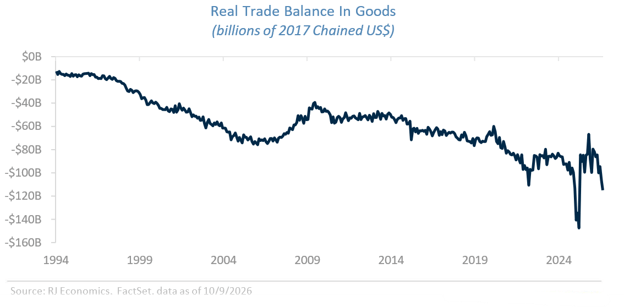
As the chart below shows, the US real goods trade deficit remained large but relatively stable, fluctuating between roughly $40 billion and $80 billion during the first two decades of this century. However, the deficit deteriorated significantly following the pandemic recession.
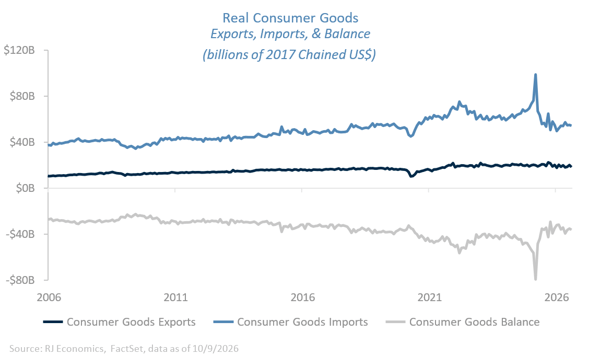
A key driver of that deterioration was a surge in consumer goods imports as households spent the excess savings accumulated during the pandemic. Real consumer goods imports eventually stabilized before surging again in the months leading up to Liberation Day, rising from roughly $60 billion to nearly $100 billion. Since then, real consumer goods imports have largely returned to pre-pandemic levels. While it is still too early to draw firm conclusions, tariffs appear to have had some effect in moderating the growth of real consumer goods imports, as shown in the graph below.
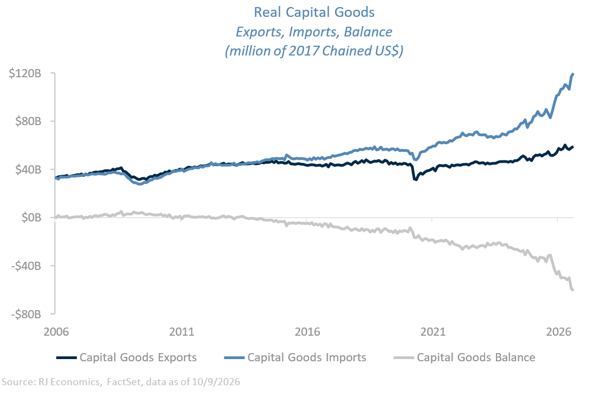
Today's real goods trade deficit, however, differs substantially from the tariff-related deterioration observed in 2025. The current widening has been building for more than a decade and reflects a different underlying dynamic. The real capital goods trade balance (i.e., machinery, equipment and other durable assets), which was roughly in equilibrium until early 2014, has steadily moved deeper into deficit and has accelerated further in recent years.
Not all trade deficits are created equal
As we have argued before, trade deficits are not inherently harmful. In this case, a widening deficit driven by capital goods imports is, in fact, a positive for the economy. Increased imports of capital goods indicate that firms are investing in future productive capacity, laying the foundation for stronger economic growth.
Although the capital goods deficit began widening around 2014, the trend gained additional momentum following the pandemic recession. The passage of the CHIPS Act and the Inflation Reduction Act, combined with the rapid expansion of AI-related investment and data center construction, has further boosted demand for imported capital equipment, as shown by the graph below.
Criticism of the AI and data center investment boom often centers on two distinct employment concerns. The first is that broader AI adoption could displace workers across industries as firms increasingly automate certain tasks. The second is that while data center construction generates jobs, these facilities require relatively few permanent employees once operational.
However, the economy is entering a period characterized by slower labor force growth, lower labor force participation and reduced immigration flows. Against that backdrop, these investments should help offset labor supply constraints by boosting productivity and expanding productive capacity. For that reason, we continue to believe that the ongoing wave of AI and data center investment will support stronger economic growth in the years ahead.
Economic and market conditions are subject to change.
Opinions are those of Investment Strategy and not necessarily those of Raymond James and are subject to change without notice. The information has been obtained from sources considered to be reliable, but we do not guarantee that the foregoing material is accurate or complete. There is no assurance any of the trends mentioned will continue or forecasts will occur. Past performance may not be indicative of future results.